

Re-Segregating Higher Ed
We welcome readers to The Higher Ed Advocate Substack by introducing you to the kind of analysis you can expect here.

Lauren Gutterman, AAUP @ UT Vice President and Karma R. Chávez, AAUP @ UT President
Roughly two years ago, we wrote an op-ed titled “Resegregating Higher Ed” about the implementation of Texas’s anti-DEI law Senate Bill (SB) 17 on our campus at the University of Texas at Austin. SB 17 went into effect in Texas in January 2024. By May, at the time of our writing, students, faculty and staff were already feeling the dire impacts of this legislation. The campus’s Multicultural Engagement Center and the Gender and Sexuality Center were being closed in accordance with SB 17’s prohibition of programs “designed or implemented in reference to race, color, ethnicity, gender identity, or sexual orientation.” UT’s Monarch program for undocumented students was also closed, even though it should not have been affected by the law. UT’s then-President Jay Hartzell had also fired more than sixty staff members who had formerly worked in DEI offices but had transitioned into new roles at the beginning of the year.
We described these changes in our op-ed as Segregation 2.0. “Rather than barring people of color, LGBTQ+ people and others from higher education entirely,” we wrote, “Segregation 2.0 works to make universities more hostile to already marginalized students, staff, and faculty and creates obstacles for them to gather, speak, and organize on campuses collectively.” At the time, we were unable to place this op-ed in either state or national media outlets. Perhaps our argument—that extremist lawmakers and university administrators were seeking to re-segregate institutions of higher education like our own—seemed too far-fetched, based on the overblown fears of a few radical faculty outliers. Editors with national news outlets, in particular, likely believed that the attack on DEI in public colleges and universities in Texas would remain limited to a handful of red states and did not warrant broader coverage.
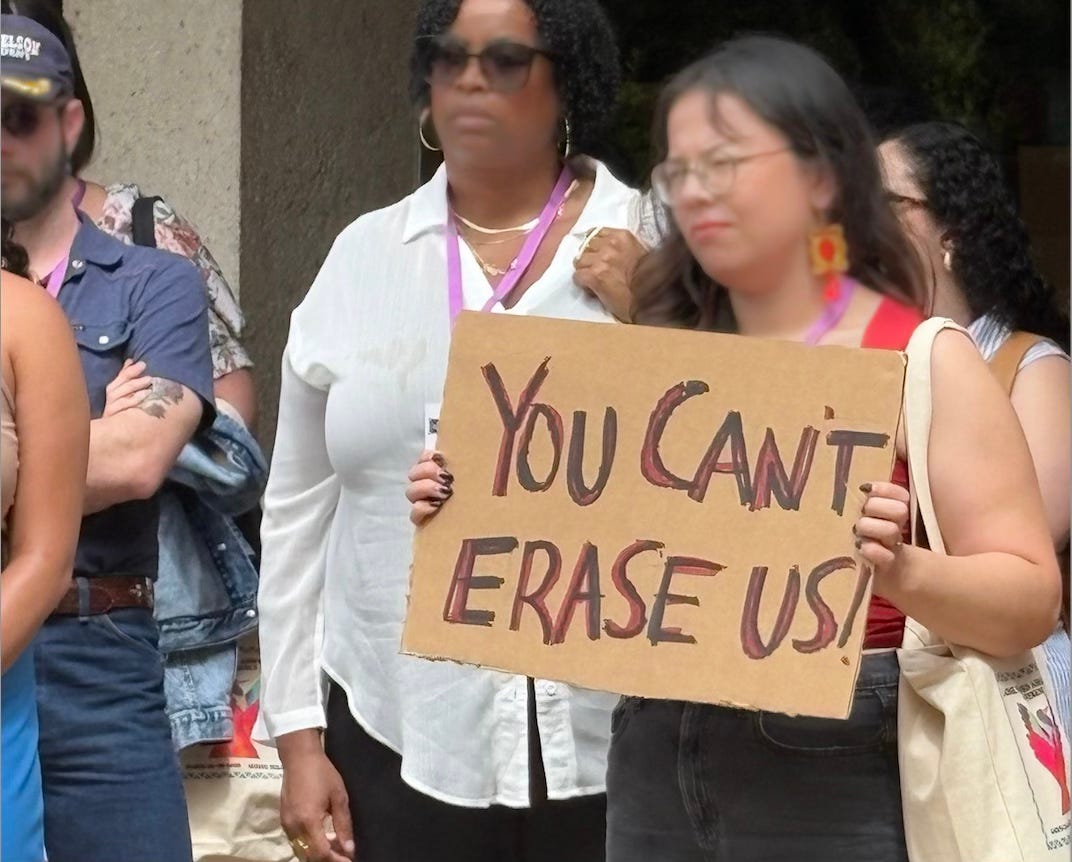
Image description: A person in a red tank top holds a cardboard sign reading “You can’t erase us!” A person in a white button-down shirt stands to the left. Photo taken at the 2026 Latinx Studies Association Conference on the UT Austin campus.
Returning to this piece more than two years later, our concerns proved all too warranted. The banning of DEI programs was an opening foray in an attempt to silence teaching and research about racial, gender, and sexual injustice and oppression. Although SB 17 notably did not apply to academic research or classroom instruction, it nevertheless contributed to a widespread chilling of teaching and learning around race, gender, and sexuality on our campus and others throughout Texas. Many faculty who did not have a detailed understanding of the law, or who believed that self-censoring would protect them, chose not to teach about concepts they feared would attract the ire of far-Right politicians. Students too became more reticent to discuss these issues among many others related to structural inequality. In some cases, university administrators used vague concerns about the law to justify the cancellation of events on LGBTQ+ topics. SB 17 paved the pathway for future incursions on academic freedom.
In the spring of 2025, the Texas legislature passed SB 37, an omnibus bill attacking public higher education from multiple angles. The bill centralized control over curriculum in the hands of each state institution’s politically-appointed governing board. It created a new “ombudsman” position within the Office of the Texas Higher Education Coordinating Board to receive complaints about faculty and staff at public colleges and universities allegedly violating state law. And it significantly weakened faculty governance by limiting the power of faculty senates and capping their elected members at no more than fifty percent of the body. The UT System voluntarily went beyond SB 37 by requiring that faculty senates across the System’s fourteen campuses and health institutions be constituted only by appointed faculty. These changes have made it easier for lawmakers to pressure university leaders to do their bidding, without consulting faculty experts.
Original language in SB 37–which was introduced by Senator Brandon Creighton, the author of SB 17 who is now the Chancellor of Texas Tech–included vague restrictions on teaching about race, sex, ethnicity, politics, and religion that did not ultimately make it into the statute. Over the past academic year, however, different public university systems in Texas, including Texas Tech, Texas A&M, and UT Austin, have each instituted their own policies restricting teaching. Creighton informed university presidents of the five Texas Tech institutions that instructors could not teach, among other things, that “individuals bear responsibility or guilt for actions of others of the same race or sex” or that “meritocracy or a strong work ethic are racist, sexist or constructs of oppression.” Texas A&M’s Board of Regents instituted a policy that “no system academic course will advocate race or gender ideology, or topics related to sexual orientation or gender identity.” And the UT System Board of Regents even more broadly limited the teaching of “unrelated controversial or contested matters” in the classroom.
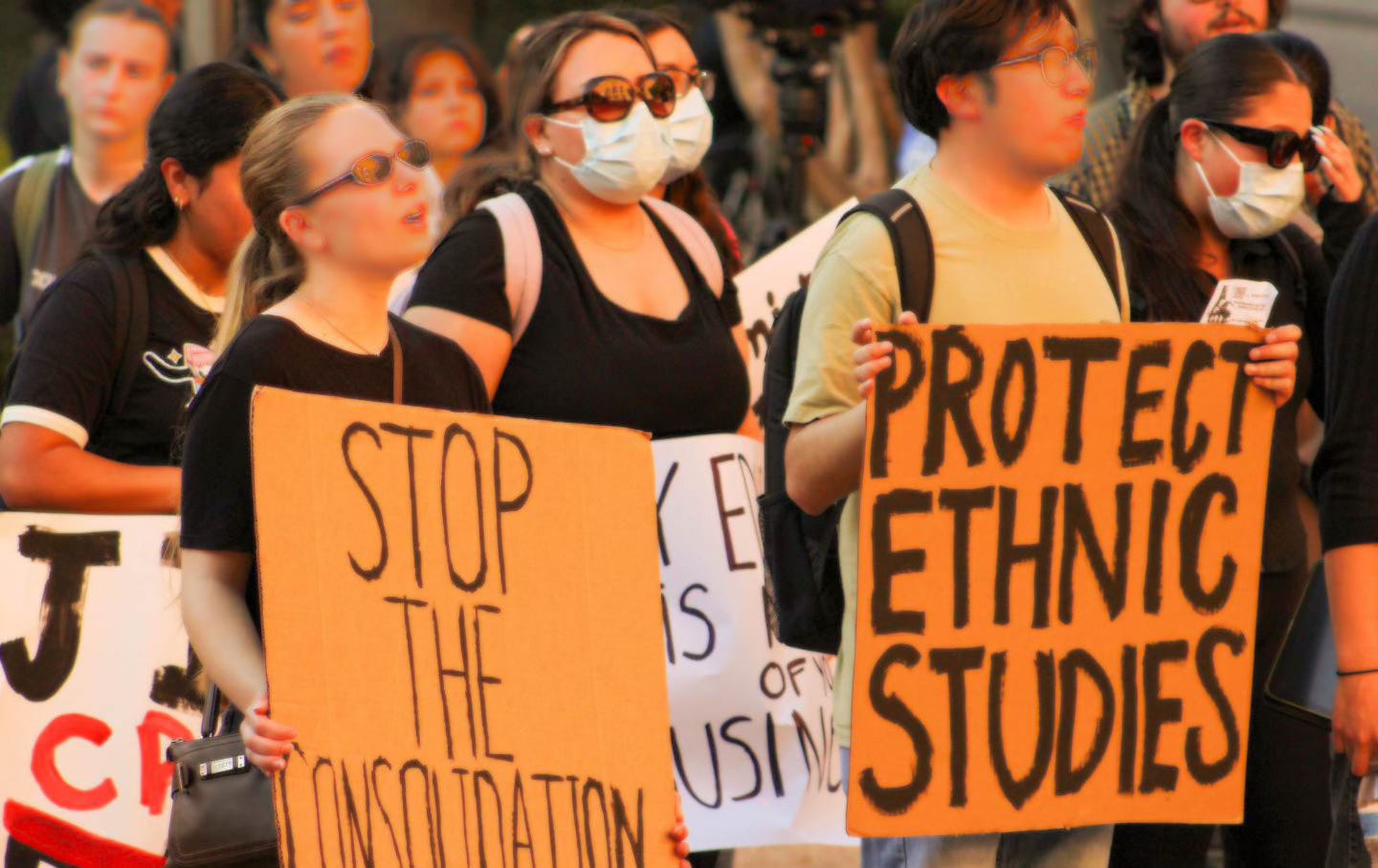
Image description: Several students stand at a protest holding signs. Two read “stop the consolidation” and “protect ethnic studies.” This protest, put on by Students for a Democratic Society, was held on UT Austin’s campus in spring 2026.
Teaching and research about race, ethnicity, gender, sexuality, and citizenship have been further undermined by the closure of academic units focused on these issues across the state. In February 2026, for example, UT Austin President James Davis announced the “consolidation” of the Departments of African and African Diaspora Studies, American Studies, Mexican American and Latina/o Studies, and Women’s, Gender and Sexuality Studies, of which we are a part. Faculty in these units will be merged into a new Department of Social and Cultural Analysis–a title that conveniently avoids naming our areas of study and refers to no recognized scholarly field. Although the College of Liberal Arts Interim Dean David Sosa originally told chairs of these departments that the “consolidation” of these units would occur in fall 2027, he later announced this timeline would be accelerated and the closure of our departments finalized by fall 2026. The only reason given for this change was the next Texas Legislative session which begins January 2027.
The resegregation of colleges and universities we identified in spring 2024 has been carried out even more quickly and with less resistance from our administrative leaders than we anticipated. In fact, our administrators have catalyzed some of the more draconian changes. As faculty in Texas working in the academic fields most directly under political fire at this moment, we are witnessing this radical transformation of higher education up close, but we are not alone. The changes we are experiencing are now manifest in states across the country, red and blue alike. Now both public and elite private institutions, including even Harvard University, are ending supportive programs and services for faculty and students of color, women, and LGBTQ+ people. Departments and programs that focus on issues of race and ethnicity and gender and sexuality are being shuttered. Together these changes send a powerful message to marginalized students and faculty: you are not welcome here.
Over the past few years it has become clear that the state laws and institutional policies limiting the freedom of students and faculty in Texas to learn and to teach are a model for a much broader, national campaign. This highly organized and well-funded backlash seeks to reverse the changes to higher education that have occurred over the past fifty years in response to student, faculty, and community demands for a more inclusive curriculum and a more diverse student and faculty body. In the face of the relentless attacks we are facing, our message today remains the same as it was in 2024: “We want a Texas and a University for everyone. We refuse to be silent in the face of Segregation 2.0, and we want to send a message to conservative legislators around the country: we are stronger when we embrace diversity, equity, and inclusion. To do anything less only replicates the grave errors of the past.”
The Higher Ed Advocate Substack is meant to serve as a space where faculty, students, staff, and community allies in Texas and across the country can share stories and information about the continuing war on higher education. Rather than relying on mainstream media outlets to amplify our voices, we wanted to create a venue in which we can speak to each other directly about what we’re experiencing and how we are fighting back. We hope you’ll follow, share, and contribute to this space in the months ahead. One thing is for sure: the extremist takeover of higher education in our state, and the nation as a whole, is far from over.